Showing posts with label memories. Show all posts

Friday, November 17, 2023

Gathering Memories

Old homestead

                                                     Berry patch (L) and brook (R) behind me

Yesterday I stood in the driveway of my brother's house that sits where a small apple orchard and fruit patch thrived when I was a child. The brook is to one side, West's hill the other and, if I glanced next door I could see the old homestead itself, now looking like someone else's house altogether. My mind's eye and my memory filled in remembered details - the bent old apple trees that looked like horses to my sisters and me to which we attached rope stirrups and reins; the thorny patch of blackberry and raspberry bushes and the stout blueberry bushes; the brook that ran along the edge of our property line before dashing through what we called the tunnel to the other side of the road where it widened into a satisfactory small pond; the giant pine across the street where we kids would crouch for hours building miniature moss and stick houses and roads lined with pine needles where imaginary pioneers lived and traveled through the bear-infested, never-ending pine woods themselves. 

When I was very small, I would pretend I was mere inches tall. Rocks became mountains, moss an impenetrable forest, a runnel of rainwater in a roadside ditch grew into a roaring river. If I sat still long enough and was quiet, the imagined scene became real and I entered the parallel dimension with ease. It would take a sudden loud noise or a tap on the shoulder to bring me back and I always returned reluctantly. By the edges of the brook, beneath the trees of nearby woods or among the cornstalks in the meadow near the house, I would lose myself in play, bothering to go home only when my stomach rumbled loud enough to rouse me or the ringing of the ship's bell on our porch calling us kids home penetrated my awareness. I always kept the house in view, though when I was hunkered down I believed no one from home could see me. For an introverted child, this state of affairs was ideal. 

I am too stiff now to hunker down and too tall to go unnoticed as I walk along the brook's edge. And I am far too big to fit through the culvert and splash into the pond. On all sides the reeds and marsh grasses and bushes have encroached until there's hardly a pond at all. In my memory, my mother is beside me, helping me find a few good-sized stones to toss into the water. "Rocks help clean the water," she'd say, and we'd throw our finds as far as we could, watching the ripples make their way to shore. 

Turning from the brook, I am assailed by another memory. Coming back from a visit to a friend's house one late winter afternoon, I stopped at the brook to listen to the water talk to itself as it splashed through the tunnel. When I looked toward my house, the kitchen light came on. I knew my mother was there, making supper, and I was flooded with such a feeling of contentment and safety that I was near tears. Just the way I am now as I recall that feeling of utter happiness. 

The brook summer 2023.


Sunday, November 12, 2023

Returning Home


I look out the window at the familiar trees of my childhood, the great pines, the lone oak still holding its leathery brown leaves on this mid-November morning. I watch the light appear in the eastern sky over the brook, watch the fingers of sunlight touch first the top of the mountain – Mama’s mountain – and trace their way slowly down to color meadow and farmhouse, and finally the familiar road I now walk along every day. All my selves, my small self, my grammar school self, my teen self and the one I was in young adulthood, my middle-aged self, home for as many visits as I could fit in my busy schedule, my now elderly self who holds them all in memory, walk the road that leads from my childhood home to what we kids called “the Corner” a mile away, a gently hilled road winding its way past fields and woods and a few houses. 


I am more at home and at peace here than anywhere else I’ve ever lived, having formed an intense attachment to the place in early childhood. As a small girl, my perimeters extended to the farm on the hill, known to us as West’s Hill because a family of that name lived there, down the hill to encompass the nearest neighbor’s farm where lived an elderly couple we called Grandma and Grandpa though they were no relation at all, across the street to the Big Pine at the edge of another meadow, and past the brook to Mary’s house with whom I chose to play on occasion. She was younger than I, falling between my own age and that of my sisters, three years younger. My older brother, though busy with other pursuits, often consented to play games with his younger sisters. We played, too, with the West kids whose farm had a delightful hill for winter sledding and whose woods were filled with wild flowers and mushrooms in the spring, and a great barn filled with cows and a grain bin filled with corn, oats, and barley mixed with molasses. 


 To be nearly home again (my childhood home lies next door to the house where I am living now) is an unexpected gift. I wake each morning with a feeling of expectancy. I walk past Grandma and Grandpa Gordon’s house now renovated to suit its new owners, up West’s hill where a newer ranch house occupies the spot where the old two-story farmhouse once sat before it burned to the ground one cold December night, along the level spot that leads to the Macchi farm where we once boarded our cow, Cecile, and did farm chores in exchange, past the Name Rocks where people in the 1800s, and later we neighborhood children, carved our names and the date, along the edge of the long hay meadow that marked the beginning of the wooded area near the Corner, to the Corner itself where stands a favorite tree I’ve become attached to over the years. Here, too, are massive rocks that hold honeysuckle in the spring, and enormous trees that I recognize from 70 plus years ago. And as I turn for the walk home, I feel the same lift of spirits I felt as a small girl, as a young woman, as a middle-aged visitor. It is possible, in a wide sense, to go home again.

Monday, May 13, 2019

Runaway Memory


runaway

behind the library
that used to be the grammar school
where the old yellow bus
cranked open its doors and
spilled us out like
so many windup toys from a bucket
there’s a patch of mowed grass
smothered in bluets
and dotted with white violets
surrounded by pine trees
I clearly remember sitting under
with Donny and Raymond
my two best friends
since none of the girls would
play with me given I was fearfully shy
and dressed in the fringed cowgirl
skirt I got for Christmas
instead of a twirly skirt with crinoline
underneath

many of the venerable pines have fallen
since my school days
their brick colored insides scraped by a foraging bear
looking for grubs, maybe
(I saw the claw marks in the soft wood
and the dark distinct mass of its calling card
in the grass at the top of the knoll)
Pine Knoll they called this place
the stretch of green grass that grew straight to the edges
before dropping off in root-gripped cliffs that fell to the swamp
a great circle of grass humps and fetid water I once escaped through
darting off in the opposite direction when
Teacher headed the line into school after recess
sliding down a short cliff and hummock-hopping
my way to the main street before hooking a right onto
my home road and showing up at the door
startling my mother.

She didn’t send me back that day
let me sit instead on the porch swing with my PBJ
and a glass of milk contemplating my deed
I still don’t regret it and only wish escape was as easy now

Thursday, November 02, 2017

Apple Time

Not my mother's apple pie but my daughter's. Just as appetizing and just as delicious!

It’s apple time, and that makes me think of Mama and how the kitchen smelled in the late afternoons of warm apples and cinnamon and buttery piecrust.

Mama was a wonderful cook. Her specialty was a foot high angel cake that always went first at church bakes sales, but what I loved best were her pies. She had a light hand with pastry and a generous one with fruit. Her confections always looked like the one in the illustration for “Billy Boy” (Can she bake a cherry pie, Billy Boy, Billy Boy?) in my Little Golden Songbook. In the picture, the delicately browned crust rounded up over a mound of cherries and steam swirled enticingly from two large vents cut in the crust. The sight of that pie always made me hungry.

Mama often baked a pie for Sunday dinner. It went into the oven on the shelf over the roast, and as it baked, the fruit juices would drip onto the meat, basting it delicately in apple or blueberry or blackberry juice. Other times she would make lemon meringue, deliciously tart and sweet at the same time, or chocolate cream, my father’s favorite. I could never wait until the pie cooled thoroughly; many a time I burned my tongue on scalding fruit or steaming custard.

If there was an abundance of apples at one time, Mama sauced some of them. Then she would make a second batch of pastry, roll it thin, trace the shape of a saucer in the dough with a sharp knife, and fold it over a generous spoonful of applesauce. She would let me dip a fork in the flour and crimp the edges. I happily sprinkled cinnamon and sugar over each turnover and could hardly wait until they were baked. Cooled and in hand, they were my favorite snack.

It’s been years since my mother and I worked together in the kitchen but it’s apple time, and in memory of her I am baking a pie. I’ve fetched her old paring knife from the drawer, taken my bowl of apples outside and pared a dozen of them while sitting on the dreaming bench in the late afternoon sunshine.

I’ve taken her old china bowl from the cupboard, the largest yellow one, and tossed the apple slices with flour and sugar and cinnamon. I’ve rolled the crust with her old green-handled wooden rolling pin, remembering the shape of her hands as she worked, and the look of her face as she blew a stray hair from her eyes.

The pie sits on the counter, redolent and delicately browned, steam spiraling from the vents cut in the top crust. It looks just like the pie in the “Billy Boy” song illustration. It looks just like a pie my mother might have made…and I have just burned my tongue.


Friday, August 25, 2017

Mirror, Mirror


On the northwest wall of my little cottage hangs a large gilt-framed mirror. It is round and slightly convex, so that if you peer into it, your face appears distorted. It used to hang above the fireplace in the house where I grew up, reflecting our daily comings and goings. I could stand in the kitchen doorway and see in duplicate my father in his green chair, my mother at the kitchen sink, and myself, dishtowel in hand, watching us all in the mirror.

I always have the feeling, when I look at it now, that if I stare into it long and deeply enough, I can see all my growing up years stored beneath its surface. There would be my first, halting steps, and the way I grabbed onto chairs and the coffee table and my father’s legs as I learned to walk. I would see my first haircut, the soft golden curls that framed my chubby baby face gone forever. Or I’d see myself sitting under my mother’s piano, a book in my lap, tracing the words with my finger as I learned to read.

My brother and sisters would be in the mirror, too. I imagine every game of marbles on the living room floor, every castle built with blocks, every game of bingo and lotto and Chinese checkers forever stored in its reflective depths. If I concentrated, I would see the day a professional photographer came to the house to take formal pictures of my brother in his crooked bowtie and my sisters and I sitting primly on the sofa in our matching plaid dresses, the mirror gleaming over our heads.

I would see my mother at the piano, playing The March of the Wooden Soldiers as we thumped around the living room in time to the music. There would be all the early suppers in front of the television, the noisy New Year’s Eve celebrations, the quiet evenings in front of the fire.

Every Christmas tree we ever had would shimmer with tinsel and colored lights behind the glass, every Easter basket revealed as the mirror recorded its hiding place. I would still be coming down the stairs in my green corduroy coat on Sunday mornings to parade back and forth in front of the mirror admiring my first high heels, or whirling about the living room with my mother as we practiced the be-bop with the kids on the Dick Clark show.
I would be there in my graduation robe, my wedding gown, my favorite bright red maternity dress. My children would appear there, snuggled with their Memeré on the couch or their Peperé in his big, green chair.

The only day not recorded in the mirror is the last day we both spent in that house. It lay on a chair, wrapped for moving, it’s face hidden as I said my goodbyes. I treasure that bit of glass and gilt now, for it’s more than just a mirror. It’s the repository of all my days.


Sunday, February 28, 2016

Sunday morning prompt - write to this quote:

"Once in his life a man ought to concentrate his mind upon the remembered earth. He ought to give himself up to a particular landscape in his experience; to look at it from as many angles as he can, to wonder upon it, to dwell upon it.
He ought to imagine that he touches it with his hands at every season and listens to the sounds that are made upon it.
He ought to imagine the creatures there and all the faintest motions of the wind. He ought to recollect the glare of the moon and the colors of the dawn and dusk."   ~N. Scott Momaday


I spent my childhood
in love with home—
with the gold/emerald grasses that knelt under my feet
and stood again after I passed,
with the spring flowers in my mother’s garden,
violets, lily of the valley, daffodils,
their breath sweet, their faces washed in sunshine,
and later, the fairy roses that climbed the fence
and hobnobbed with the first cut hay;


with the rough rocks that lined the banks
of the small brook that cut a path
through barbed and tangled berry bushes,
ripe with bee-spun fruit;
with the bent branches of an old apple tree
I climbed on, pretending I was astride a unicorn;
with the dirt road that, once tarred over,
led me past neighboring farmland, past deep woods
where I would prowl, looking for signs of bear
or wild Indians, half Indian myself, walking toe first
through the crackling underbrush;


with the staccato tap of rain on leaves
the warm, green-brown scent of wet earth
and great equinoctial storms
that presaged the change of seasons;
with my small, cross-legged self,
small among the cornstalks,
watching a chipmunk forage for kernals,
and once, a stately antlered buck watching me;


with the drift and spin of painted leaves,
touched by the brush of frost
and the tented webs that glimmered
red and blue and glittering silver on September lawns;
with the first snowflakes whispering on a chill wind
with knee-deep drifts, and sleds,
and green Christmas mittens, up-turned collars
and scratchy scarves, snowpants that swished,
galoshes with frozen buckles that finally yielded
to small, determined, snow-frozen fingers;
with March winds that rattled the old wooden shutters,
blew snow that piled in small drifts
on the window sills and etched icy ferns on the panes;


with the return of robins, blue eggs huddled in a nest
I could spy on from the upstairs window,
finding great comfort in the way
the parent birds looked after their young
until, at last, the babies flew.


Saturday, June 15, 2013

In My Father’s Footsteps (Repost)


My first memory of my father is a visual one. I am a toddler and I am sitting on the floor behind the brown chair in the living room. Before me are two polished black shoes and two very long legs clad in khaki. Those long legs would often make a bridge between Dad’s favorite green chair and its matching hassock and we children would try to crawl under him without being caught. It was a favorite after-dinner game.

Dad raised chickens for a living. In the army he’d been responsible for training the carrier pigeons that flew messages from platoon to platoon. His peacetime job involved several hundred chickens, a brooder house, a long hen run, and a slaughter shed where he killed and dressed the birds for market. The farm was lost first to a flood that left hundreds of carcasses across the yard and garden. Dad restocked, only to learn the chickens were diseased and this second setback cost him the farm.

The years that followed were difficult. There were four children to feed and a mountain of debt. For a while, Dad worked the night shift at a lime kiln. By day, we children had to be very quiet so as not to waken him while he slept away the sunny morning hours. We spent a lot of time in the abandoned chicken houses, running races down the long hen run or roller-skating on the cement floor of the brooder house. On weekends and sometimes after school, Dad took my brother and me hunting. We ate whatever was in season—rabbit, duck, partridge, grouse, venison. He loved to fish as well as hunt and fishing season often found us knee deep in some cold stream, angling for a few trout for dinner. We never went hungry.

In the 1950s, Dad went to work for the Post Office as a rural route carrier. Before the law was passed that would not allow a mailman to carry passengers in his car, we sometimes rode with him, helping to deliver phone books or shovel snow from mailboxes. Dad was good at his job. He liked people and never passed up a chance to be helpful, often delivering messages and meals to shut-ins. The people on his route paid him in kind. Every Christmas, he would come home with dozens of gifts from grateful patrons.

Dad wasn’t much of a gardener, preferring ball games and evenings with his friends to digging in the dirt. Still, every spring he worked with my mother to plant tomatoes and peas, squash and cucumbers, and long rows of string beans. Sometimes he and I would take the big dishpan, fill it with bright green pea pods, then sit together under the maple tree to shell them for dinner. We would hunt for morels in May, gathering hands full to sauté in garlic and butter. He knew where every stalk of wild asparagus grew.

We owned an old push mower and summer evenings would find him cutting the lawns. I loved to follow along behind him, watching the grass fly from the whirring, clattering blades. When the chores were done, he and my mother would play baseball with us on the front lawn. Using trees and doorsteps for bases, we hit and ran, yelling and laughing until it was too dark to see the ball.

Years after marrying and moving away, and years after my father died, I moved back to the old family homestead. I worked in the garden, remembering those long ago days when Dad and I planted vegetables together. I followed in his footsteps as I mowed the lawn or searched for wild asparagus along the roadsides. Often just at dusk, when the fireflies began to twinkle and the last of the light was fading, I thought I could hear him calling me to come in. His presence was just a memory but it is a memory that pervades the very fiber of my being.

Thank you Hilary!

Saturday, May 25, 2013

A Bag Full of Memories


I was cutting up an old shirt for rags today – a trick my thrifty mother taught me - and it brought to mind the old ragbag that used to hang on a hook inside the attic door when I was a child. I loved that ragbag. Every one of those rags had once been an article of family clothing or a piece of bed linen or an old towel. I might dust the furniture with a bit of my first-day-of-school dress with the balloons on the collar, polish the silver with a scrap of embroidered linen that was so tattered it couldn’t be used for anything else, or wipe down the woodwork with a piece of checkered toweling that once dried the dishes after Sunday dinner. I knew a story for each rag.

If you dug through the ragbag you might find a bit of lace that once decorated a pillowcase, or a length of satin ribbon cut off an old blanket. These things were just right for fancying up a doll’s dress or fashioning a tiny coverlet for an oatmeal box cradle. There were frayed jeans that couldn’t hold one more patch but could be cut into patches themselves, squares cut from flannel nightgowns that made pillow warmers for aching ears, bits of old t-shirts that were great when the car needed waxing.

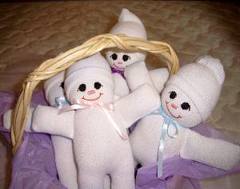
In the ragbag, too, were old, discarded nylon stockings, perfect for stuffing handmade pillows or for cutting strips to tie up the staked tomato plants. I once commandeered a still healthy sock of my father’s (the other had a gaping hole in the toe and was reincarnated as a dust cloth) and stuffed it with cut up nylons. I embroidered a face on the stuffed and rounded foot, cut arms and legs from the cuffed end, and stitched on some wool yarn hair. My small son carried Sammy the Sock Doll everywhere. When Sammy got dirty, he spent half an hour in the washing machine and an equal amount of time in the dryer. Never was a sock so well worn, or so loved.

The ragbag was a bag full of memories – the satin Christmas dress Mama stitched for my favorite doll, the linen cutwork cloth that used to grace my Memeré’s Thanksgiving table, the blue suit I wore the first time a boy asked me to dance, a bit of lace from my father’s christening gown, the navy and white skirt my mother wore to my high school graduation, my favorite brown sweater, worn to rags. We cleaned and dusted, mended and polished with those memories.

I carefully fold the pieces I cut today from the worn and frayed shirt, recalling my sleepy-headed daughter padding around the kitchen wrapped up in its warm, brown bulk. When I dust the furniture, I will remember how she helped me move into my wee cottage and how later, she single-handedly rearranged everything by herself to create an office space for me as a surprise for Mother’s Day.

I don’t have an attic here, but I do have a ragbag full of memories. I’ll take them out to dust or polish or mend - and remember.


Thanks, Hilary!


photo credit: crookedhousecreations.com